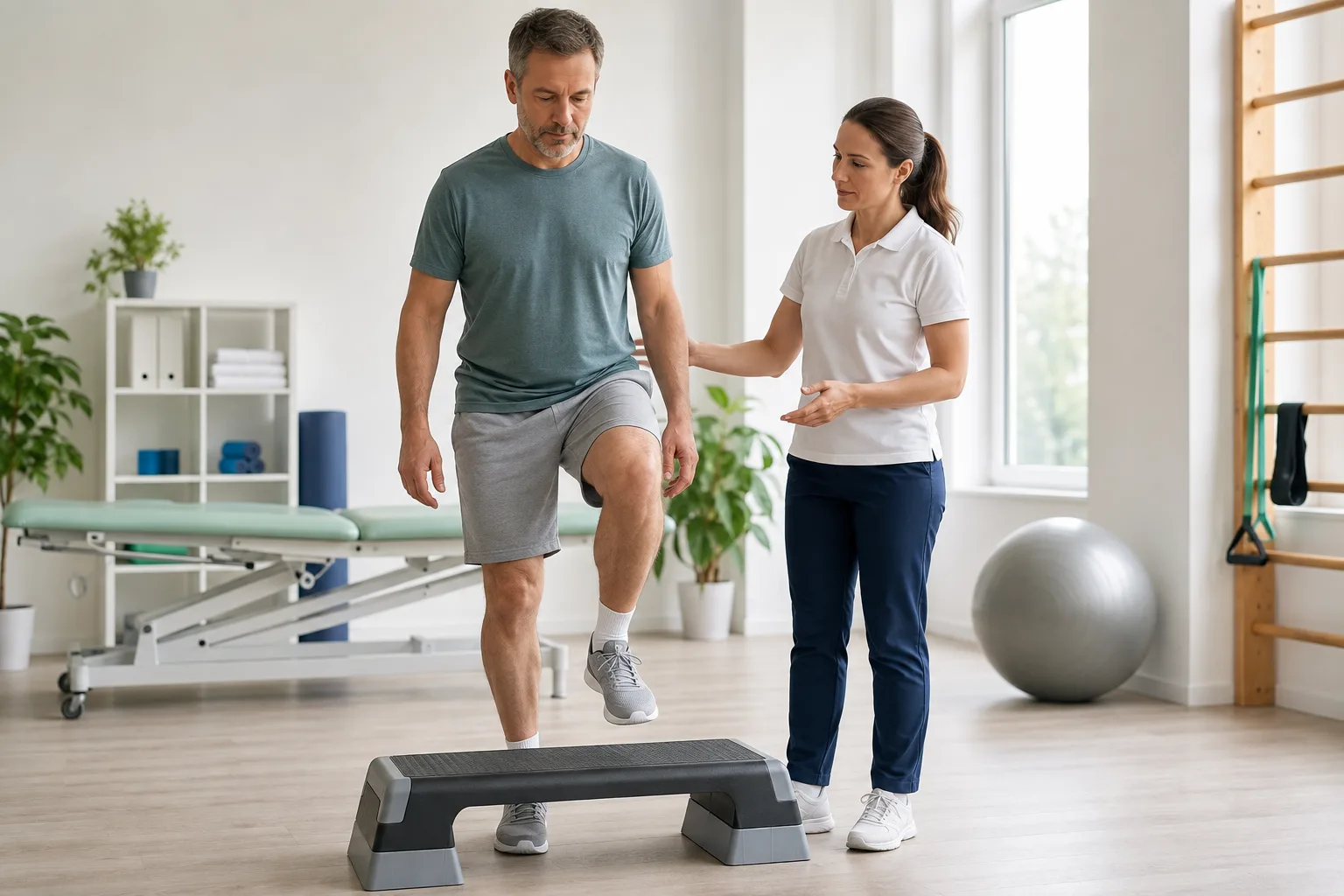
After an injury: a complete guide to recovery, rehabilitation, and a safe return to movement
What should you do after an injury? This practical guide explains warning signs, assessment, rehabilitation stages, and a safe return to movement, work, and sport.
Important note
This guide explains the usual decisions and stages that may follow a musculoskeletal injury. It can help you recognise when an injury needs urgent assessment, prepare for a consultation, understand the roles of different professionals, and ask useful questions about rehabilitation and returning to activity.
It cannot diagnose an injury, rule out a fracture or other serious damage, prescribe treatment, or decide when a particular person is ready to return to work or sport. Those decisions require an examination and sometimes imaging or other tests.
If an injury followed a major accident, the limb looks deformed, a bone is visible, bleeding will not stop, the injured area becomes cold, pale, blue, or numb, or the person has problems with breathing, consciousness, movement, or sensation, seek emergency help. In Czechia, call 155 for emergency medical services or 112 for the European emergency number. Both numbers are available free of charge.
Recovery is not a countdown
After an injury, one question appears quickly: “How long until I am back to normal?” It is an understandable question, but recovery rarely works like a timer.
Two people can injure the same body area and follow very different paths. One may have a minor soft-tissue injury that improves with a short period of protection and gradual movement. Another may have a fracture, a major ligament injury, nerve involvement, or a problem that had already been developing before one painful moment brought it to attention. Age, previous injuries, general health, work, sleep, confidence, and the demands of the activity all influence what “recovered” means.
Healing is also not identical to readiness. A tissue may have progressed biologically while the person still lacks strength, coordination, endurance, or confidence. Conversely, pain may settle before the injured area is prepared for sudden changes of direction, heavy lifting, repeated impact, or a full working day.
A useful recovery plan therefore answers more than “How many weeks?” It should clarify:
- what may have been injured;
- whether anything dangerous or time-sensitive needs to be excluded;
- what the injured area can safely do now;
- which professional should guide the next step;
- which milestones will show that capacity is improving;
- what the person needs to do in daily life, work, or sport;
- how progress will be reviewed and the plan adjusted.
The World Health Organization describes rehabilitation as care that helps people optimise functioning and reduce disability in interaction with their environment. That definition matters. The goal is not simply to make an image look better or reduce a pain score. It is to help a person regain the activities that matter to them as safely and sustainably as possible.
Guide map
- The first decision after an injury: emergency signs, urgent assessment, and sensible early steps.
- What may have been injured: bones, joints, ligaments, tendons, muscles, nerves, and overload problems.
- Who does what: trauma care, general practice, orthopaedics, rehabilitation medicine, physiotherapy, and sports medicine.
- How an injury is assessed: history, examination, imaging, and the limits of scan results.
- Building a treatment plan: goals, conservative care, surgery, symptom control, and shared decisions.
- The stages of rehabilitation: protection, mobility, strength, task-specific capacity, and participation.
- Common recovery situations: sprains, knee injuries, muscle injuries, tendon problems, shoulder injuries, fractures, and postoperative care.
- Returning to everyday life, work, and sport: readiness criteria, graded exposure, confidence, and communication.
- Setbacks and repeat injuries: how to respond when recovery does not follow a straight line.
- Records, follow-up, and coordination: keeping the care journey connected.
At the end of the guide, you will find a short glossary and the sources and editorial basis.
Part I. The first decision after an injury
The first useful question is not “Which exercise should I do?” It is “How quickly does this need to be assessed?” A sensible response depends on the mechanism of injury, the symptoms, and the person’s overall condition.
When to call for emergency help
Call 155 or 112 after an injury when there may be a threat to life, circulation, the brain, spinal cord, or a limb. Warning signs include:
- loss of consciousness, increasing drowsiness, confusion, a seizure, or repeated vomiting after a head injury;
- new weakness, paralysis, marked loss of sensation, or loss of bladder or bowel control after an injury;
- difficulty breathing, chest pain, coughing blood, or severe pain in the chest, abdomen, pelvis, neck, or back after significant trauma;
- heavy bleeding that does not stop with firm direct pressure;
- an open wound with a visible bone or a severely deformed limb;
- a hand or foot that becomes cold, unusually pale, blue, or numb below the injured area;
- an injury caused by a major fall, traffic collision, crushing force, or another high-energy event, especially if the person feels faint or rapidly deteriorates;
- any situation that appears immediately dangerous, even if the exact injury is unclear.
Do not move someone after major trauma if a neck or spinal injury is possible unless remaining in place creates a more immediate danger. Follow the emergency operator’s instructions. Do not try to straighten a visibly deformed limb or push exposed tissue back into a wound.
The guidance on head injury assessment and early management explains why symptoms such as altered consciousness, repeated vomiting, neurological changes, and certain high-risk mechanisms require structured assessment. The Government of Czechia lists 155 and 112 among the national emergency numbers.
When an injury needs prompt assessment
Not every urgent injury requires an ambulance. Same-day or prompt medical assessment may be appropriate when:
- you cannot use the limb normally or cannot take several steps after a new lower-limb injury;
- pain, swelling, or bruising is severe or increasing quickly;
- a joint feels grossly unstable, locks, or cannot move through its usual range;
- you heard or felt a snap or pop and immediately lost function;
- there is a deep wound, a bite, contamination, or concern about tetanus protection;
- numbness or tingling persists, even if the limb is not cold or discoloured;
- a finger, toe, shoulder, kneecap, or another joint may have dislocated and has not returned to its normal position;
- the person has osteoporosis, a bleeding disorder, takes anticoagulants, has reduced sensation, or is otherwise at higher risk of complications;
- symptoms follow a head injury, even if the person initially felt well;
- pain is out of proportion to the visible injury or continues to escalate despite rest and simple measures.
In children, older adults, and people with conditions that affect sensation or bone strength, a serious injury may follow a mechanism that appears relatively modest. If the situation is uncertain, a medical service can help determine whether emergency, urgent, or routine assessment is the appropriate route.
What you can do while arranging care
Early care should be simple and should not create additional injury.
Stop the activity and protect the area from another impact or load. If a hand or wrist is swelling, remove rings, a watch, or tight jewellery before they become trapped. Support an injured limb in a comfortable position. Cover an open wound with a clean dressing. For significant bleeding, apply firm direct pressure unless an object is embedded in the wound.
Cold may reduce pain for some people when used briefly with fabric between the cold pack and the skin. It should not cause numbness, skin damage, or discomfort, and it should not be treated as a way to prove that an injury is minor. Evidence does not support presenting ice as a method that guarantees faster tissue healing.
Elevation and light compression may help some forms of swelling, but compression is not suitable when there are signs of impaired circulation, a possible fracture or dislocation, severe pain, or uncertainty about how to apply it. A bandage should never make the area colder, paler, bluer, more painful, or numb.
The modern “PEACE and LOVE” framework for soft-tissue injuries emphasises protection from excessive early load followed by education and a progressive return to movement, rather than prolonged complete rest. It is a broad framework, not a personal treatment plan, and it does not apply unchanged to fractures, dislocations, major trauma, or postoperative restrictions. The original framework is described in a clinical commentary describing the framework.
Avoid turning the first hour into a stress test
Repeatedly testing an injury with another squat, jump, run, or forceful stretch can add load before the problem is understood. A temporary ability to perform a movement does not rule out injury. Do not straighten a deformed area, relocate a joint, aggressively stretch a new injury, use alcohol for pain, or borrow prescription medicine.
For over-the-counter pain relief, follow the product instructions and ask a pharmacist or doctor if you have kidney disease, liver disease, stomach ulcers, cardiovascular disease, asthma affected by medicines, take anticoagulants, are pregnant, or use other medicines. A general guide cannot choose the safest product for an individual.
A simple record of what happened
Once the situation is stable, note the time, activity, exact movement or impact, any pop or snap, immediate loss of function, the development of swelling or bruising, neurological symptoms, and any first aid or medicine used. A photograph taken with consent can document visible changes. This record does not replace assessment, but it gives the clinician a clearer timeline than memory alone often provides.
Part II. What may have been injured
Pain identifies a problem, but it does not label the tissue. Several structures can be affected together, and similar symptoms can have different causes.
| Structure | What an injury may involve | Details worth reporting |
|---|---|---|
| Bone or joint | Fracture, loss of alignment, or injury inside a joint | Deformity, inability to use the limb, rapid swelling, locking, or giving way |
| Ligament | A sprain ranging from limited fibre damage to a complete rupture | Twist, pop, swelling, instability, and the activity that now feels unsafe |
| Muscle | Injury after acceleration, lifting, sudden stretch, or direct impact | Location, bruising, weakness, and which movement became difficult |
| Tendon | Sudden tear or a gradual load-related problem | Snap, major loss of function, morning symptoms, and recent changes in load |
| Nerve | Stretch, compression, bruising, or another source of altered nerve function | Persistent numbness, burning, weakness, or loss of coordination |
| Blood vessel | Reduced circulation or bleeding around the injury | A cold, pale, blue, or increasingly numb extremity is an emergency sign |
The ability to move does not reliably exclude a fracture, and bruising does not grade a muscle or ligament injury. A joint that appears to return to place after a possible dislocation can still have associated damage. Sudden major weakness after a snap can indicate a tendon rupture and deserves prompt assessment.
Some problems have a clear moment of injury. Others develop when repeated demand exceeds current capacity. Many sit between those categories, so mention changes in training, work, footwear, surface, equipment, sleep, illness, and previous injury even when there was no single accident.
Pain is important, but it is not a direct damage meter. Describe its effect on function: whether you can walk, grip, lift, sleep, or use the joint; whether symptoms settle or remain worse later; and whether the pattern is improving. Severe pain can occur without catastrophic damage, while some serious injuries initially cause limited pain. Clinical context matters more than a number alone.
Part III. Who does what during recovery
Musculoskeletal care often involves several professions, but more appointments do not automatically create better care. Each professional should have a clear role, and the plan should answer who is leading clinical decisions, who is guiding rehabilitation, and who will review progress.
Emergency and trauma care
Emergency medical services and hospital trauma departments focus first on threats to life, limb, circulation, and neurological function. They assess serious mechanisms, stabilise injuries, treat wounds, reduce some dislocations, arrange urgent imaging, and involve surgical teams when required.
General practitioner
A general practitioner can be a useful first contact when the injury is stable, the correct specialty is unclear, symptoms have persisted, or general health may affect recovery. The GP can consider medicines, chronic conditions, previous health information, work incapacity, and the need for referral or further investigation.
Orthopaedist
Orthopaedics focuses on the musculoskeletal system, including bones, joints, ligaments, tendons, and related structures. An orthopaedist may assess a suspected fracture, instability, mechanical joint problem, significant loss of function, persistent symptoms, or a condition in which procedural or surgical options may need consideration.
Seeing an orthopaedist does not mean that surgery will be recommended. Many orthopaedic problems are managed conservatively.
Rehabilitation physician
A rehabilitation physician looks at diagnosis, function, medical factors, and the overall rehabilitation plan. This role is particularly useful when recovery is complex, several body areas or health conditions are involved, pain and function do not follow the expected course, or multiple therapies need to be coordinated.
Physiotherapist
A physiotherapist assesses movement and function, then uses education, exercise, graded activity, and selected approaches to support mobility, strength, balance, gait, load tolerance, and the movements required for work or sport. Each intervention should connect to a functional goal. World Physiotherapy describes the profession as including assessment, planning, intervention, and evaluation.
Sports medicine physician
Sports medicine is relevant not only to elite athletes. A sports medicine physician can assess exercise-related symptoms, the medical safety of training, performance-limiting problems, recovery after injury, and the demands of returning to recreational or competitive sport.
Surgeon
Some fractures, tendon ruptures, ligament injuries, joint damage, and complications require a surgical opinion. The surgeon decides whether an operation is likely to offer a meaningful advantage over non-operative care, explains alternatives and risks, and sets procedure-specific restrictions.
Surgery is one event within recovery. Postoperative instructions take priority over general advice because the procedure and internal repair determine what can be loaded and when.
A practical starting table
| Situation | Possible first contact | Important qualification |
|---|---|---|
| Major trauma or emergency warning signs | Emergency services or trauma department | Do not wait for a routine specialist appointment |
| Possible fracture, dislocation, major tear, or sudden major loss of function | Urgent medical or trauma assessment | Imaging and circulation or neurological checks may be needed |
| Stable joint injury with persistent swelling, instability, locking, or loss of movement | Orthopaedist or an appropriate medical entry point | Earlier assessment may be needed if function is severely limited |
| Complex recovery, several medical factors, or persistent functional limitation | Rehabilitation physician | Useful when a coordinated medical rehabilitation plan is needed |
| Movement, strength, balance, gait, or graded loading problem after serious injury has been excluded or stabilised | Physiotherapist | The therapist should work within medical and postoperative restrictions |
| Exercise-related injury or decision about returning to demanding sport | Sports medicine physician | Readiness may include medical, functional, and sport-specific factors |
| Unclear symptoms or a problem mixed with general health concerns | General practitioner | The GP can assess the broader picture and direct the next step |
These routes can overlap. The best first contact depends on availability, urgency, local referral pathways, insurance conditions, and the nature of the injury. A receptionist or coordinator may help with routing, but clinical triage and treatment decisions belong to healthcare professionals.
One plan, not six separate opinions
When several professionals are involved, ask these questions:
- What is the current working diagnosis?
- Who is responsible for changing restrictions?
- Which activities are permitted, limited, or temporarily avoided?
- What is the rehabilitation goal for the next phase?
- Which finding would trigger repeat imaging or another specialist review?
- Who decides about return to work, driving, training, or competition?
- When and how will the team exchange updated information?
Conflicting advice sometimes reflects different information rather than true disagreement. One clinician may have seen the scan but not the recent functional progress. Another may know how the person moves in therapy but not the operative details. Sharing records and asking for one explicit plan can resolve avoidable confusion.
Part IV. How an injury is assessed
A scan can be useful, but the assessment begins before imaging. The clinician needs to understand what happened, what changed immediately, how symptoms have evolved, and what the person needs to regain.
The history of the injury
Expect questions about the mechanism, onset, immediate and delayed symptoms, ability to use the area, previous injuries, recent changes in load, the activity you want to regain, medical conditions, and medicines.
“I hurt my knee” describes a location. “My planted foot stayed still while my body turned, I felt a pop, the knee swelled within two hours, and it now gives way on stairs” gives the clinician a sequence to examine.
The physical examination
Depending on the injury, the clinician may inspect alignment, swelling, bruising, wounds, muscle bulk, and movement. They may check tenderness, active and passive range, strength, joint stability, sensation, pulses, reflexes, gait, balance, or a task related to work or sport.
Pain, guarding, swelling, or a suspected fracture may limit the first examination. A provisional diagnosis can be revised as symptoms settle or new information becomes available.
What different imaging methods can show
X-ray assesses bones, alignment, and some joint changes, but has limited value for many soft tissues.
Ultrasound can show selected superficial tissues dynamically. Its usefulness depends on the clinical question and operator expertise.
MRI shows many soft tissues, bone marrow, and joints in detail. It is useful when the result could change management, not for every painful joint.
CT provides detailed cross-sectional images for selected fractures and trauma questions. It uses ionising radiation.
Clinical decision rules and professional imaging criteria help clinicians decide when a test is appropriate. The American College of Radiology Appropriateness Criteria organise imaging recommendations around specific clinical scenarios. The guidance on non-complex fracture assessment and management also includes assessment and imaging recommendations for common suspected fractures.
Why “no scan” does not always mean “nothing is wrong”
Imaging is useful when it answers a question that can influence treatment. It can be unnecessary when the examination already supports a safe plan, the result would not change early management, or symptoms should first be observed over an appropriate period.
Avoiding an unnecessary scan is not the same as dismissing pain. A clinician should still explain the working diagnosis, expected course, warning signs, and review plan. If the course differs from what was expected, the decision about imaging can be revisited.
Why a scan result is not the whole diagnosis
Imaging can reveal changes that existed before the injury and may not be causing the current symptoms. Terms such as degeneration, wear, disc bulge, tendon change, or cartilage defect can sound alarming when read without context. Their relevance depends on age, symptoms, examination, mechanism, and function.
The reverse is also possible. A scan report may appear reassuring while the person still has important pain or functional limitation. The right question is not simply “Is the scan normal?” It is “Does this finding explain the clinical picture, and does it change what we do?”
Questions to ask about a test
Before or after imaging, ask:
- What specific question is this test intended to answer?
- How could the result change the treatment plan?
- Is there a reason to do it now rather than after a period of observation?
- Are previous images needed for comparison?
- Who will explain the report in relation to the examination?
- What happens if the result is inconclusive?
Keep both the written report and access to the images when possible. A future specialist may need the actual study rather than only a summary.
Part V. Building a treatment plan
A diagnosis is useful because it guides decisions, not because it provides a complete recovery plan on its own. A strong plan connects medical safety, tissue protection, symptoms, function, and the demands of the person’s life.
Start with a working diagnosis and a review point
Sometimes the first assessment provides a clear diagnosis, while sometimes the clinician monitors a likely explanation. The patient should still understand what may be happening, which serious possibilities were considered, what is safe now, what remains restricted, what improvement is expected, and when review is needed.
Uncertainty should be described, not hidden. “The examination is most consistent with a moderate ankle sprain, but we will reassess weight-bearing and focal bone tenderness in several days” is more useful than false certainty.
Define goals in terms of life
“Less pain” is a valid goal but rarely the only one. A concrete goal might be walking to public transport without a limp, lifting a child, completing a work shift, jogging continuously, changing direction under control, or completing training and recovering normally the next day.
The same diagnosis can require different plans for an office worker, a warehouse employee, a musician, a parent caring for a toddler, and a competitive athlete.
Conservative care is active care
Conservative or non-operative care may include education, protection or bracing when indicated, progressive exercise, movement retraining, activity modification, symptom management, and follow-up. It should not mean “do nothing and hope.”
The plan needs enough protection for healing without unnecessary loss of movement and capacity. The balance differs by injury. A stable soft-tissue problem may benefit from early controlled movement. A fracture, repaired tendon, or reconstructed ligament may require specific restrictions. General internet advice cannot safely erase those differences.
When surgery enters the discussion
The decision about surgery can depend on alignment, instability, tissue damage, age, health, symptoms, occupation, sport, previous treatment, and the likely consequences of operative and non-operative care. Urgent surgery is needed for some injuries, while other decisions allow time for discussion or a trial of conservative treatment.
Ask what the operation is intended to solve, which non-operative alternatives are reasonable, what delay would mean, and what the main risks are. Also clarify restrictions, the rehabilitation protocol, milestones for work or sport, and how complications or slower progress will be handled.
A second opinion can be reasonable when the decision is preference-sensitive, the diagnosis is uncertain, the proposed procedure is major, or the person does not understand why one option is recommended. Urgent care should not be delayed solely to collect multiple opinions when delay could worsen the outcome.
Symptom control should support the plan
Pain relief can make sleep, basic movement, and participation in rehabilitation more manageable. Medication choices depend on health conditions, other medicines, allergies, pregnancy, and the injury or procedure. Follow the treating clinician’s instructions and avoid assuming that an over-the-counter product is safe for everyone.
Braces, taping, orthoses, manual techniques, injections, and physical modalities may have a role in selected cases. Ask what problem each intervention addresses, what benefit is expected, how that benefit will be measured, what risks or costs are involved, and what active part of recovery it supports.
An intervention that temporarily changes pain can be useful. It should not automatically be interpreted as proof that tissue has healed or that unrestricted loading is safe.
Shared decisions require usable information
The clinician brings medical knowledge and experience. The patient brings priorities, tolerance of risk, work realities, family responsibilities, and the meaning of the desired activity. A decision is genuinely shared only when both are visible.
If the plan is unrealistic, say so early. Someone who cannot attend therapy three times a week, cannot avoid stairs at home, or must perform manual work needs the team to know. The answer may involve a different schedule, home exercises, workplace modification, sick leave, support from family, or another clinical route. Hidden practical barriers often become medical setbacks later.
Part VI. The stages of rehabilitation
Rehabilitation is often described in phases. Real recovery does not move through them in perfectly separate blocks, but the model helps explain why treatment changes over time. A person may be restoring movement while already rebuilding strength, or may temporarily return to an earlier level after a flare.
Stage 1: safety, protection, and basic function
The first stage is about preventing avoidable harm while preserving safe function. Priorities may include monitoring warning signs, protecting the injured structure, managing wounds and symptoms, maintaining movement in unaffected areas, using supports correctly, and performing essential daily tasks.
Restrictions should be precise. “Take it easy” can mean ten different things. Ask whether weight-bearing is prohibited, partial, or allowed as tolerated; whether a brace must remain on at night; whether a joint has a movement limit; and when the restriction will be reviewed.
Complete rest can reduce capacity, while early loading can be unsafe for particular fractures, repairs, and unstable injuries. The treating team must define the safe middle ground.
Stage 2: restoring movement and control
As protection allows, the focus commonly expands to joint movement, muscle activation, gait, basic balance, and control. The aim is not to force the body into the largest possible range. It is to regain useful movement without repeatedly provoking the injury or violating medical restrictions.
The physiotherapist may compare sides, observe compensations, and select exercises for the current level. Progress can be tracked through movement, swelling, walking pattern, exercise load, balance, or tolerance of daily tasks.
Stage 3: rebuilding strength and capacity
Rehabilitation rebuilds the capacity to accept and produce force through progressive resistance, endurance, balance, coordination, and movement at relevant speeds. Difficulty can change through resistance, repetitions, range, speed, complexity, frequency, surface, or recovery time. Increasing everything together makes the response difficult to interpret.
The dose is individual. Patients need a clinician-defined response rule stating which symptoms are acceptable, how long they may last, and when an exercise should be reduced or stopped. “Push through” and “stop whenever anything hurts” are both too vague.
Stage 4: preparing for the real task
Basic strength does not automatically prepare someone for work or sport. This phase introduces relevant demands such as repeated lifting, prolonged standing, running, landing, changing direction, overhead work, contact, equipment, and performance while tired.
Specificity does not mean copying the hardest task immediately. It means building a bridge from controlled exercise to the final environment. A runner may progress from walking to short run-walk intervals before continuous running. A football player may move from straight-line running to planned direction changes, then reactive drills, non-contact training, full training, and competition.
Stage 5: returning to participation and performance
Return is not one event. The 2016 international Bern consensus on return to sport describes a continuum:
- return to participation, when a person is active again but not yet ready for unrestricted sport;
- return to sport, when the person has returned to the sport but may not yet perform at the previous level;
- return to performance, when performance has returned to or exceeded the previous level.
This distinction also applies outside sport. Returning to a workplace for shorter duties is different from completing every task at full pace. Walking around the home is different from navigating a full day in the city. A staged return can be a treatment tool rather than evidence that recovery has failed.
Milestones are more useful than a single deadline
A date can help with planning, but milestones show whether the person is ready to progress. They may include medical stability, acceptable symptom behaviour, sufficient movement and strength, controlled performance, tolerance of repeated sessions, a work or sport simulation, and psychological readiness.
Milestones must be selected for the individual. Passing one hop test does not clear every athlete. Symmetrical strength does not necessarily mean that both sides are strong enough. Feeling no pain during a warm-up does not show how the body will respond after a full session.
The home programme is part of treatment
Most recovery occurs outside the clinic. A home programme should be small enough to follow and should state each exercise’s purpose, dose, expected effort, acceptable symptom response, stop rule, and progression.
More exercise is not always better. Adding online exercises to a prescribed programme can duplicate load or contradict restrictions. If the plan feels too easy, too painful, or impossible to fit into daily life, ask for an adjustment instead of silently replacing it.
Recovery is affected by the whole person
Sleep, nutrition, energy availability, smoking, alcohol, stress, mood, other illnesses, and medication can influence recovery and participation. These factors should not be used to blame the patient. They are parts of the clinical context that may be modifiable or may require support.
Persistent fear of movement deserves attention. Caution is rational after a painful injury, but fear can remain after the immediate danger has passed and restrict useful activity. A graded plan, clear explanations, and successful exposure to increasingly demanding tasks can rebuild trust. Severe anxiety, low mood, disordered eating, or difficulty coping may require support beyond the musculoskeletal team.
Part VII. Common recovery situations
The examples below show why similar words such as “sprain,” “tear,” or “overuse” can lead to different plans. They are not home diagnostic guides or treatment protocols.
What changes the recovery plan
| Situation | Early clinical question | Later rehabilitation focus |
|---|---|---|
| Ankle sprain | Is there a fracture, dislocation, major instability, or circulation problem? | Walking, calf and ankle strength, balance, then the required running or direction changes |
| Knee injury | Which combination of ligament, meniscus, cartilage, tendon, or bone may be involved? | Movement, strength, control, running, jumping, and task-specific exposure as appropriate |
| Muscle injury | Where is the injury, how much function was lost, and what movement caused it? | Progressive strength at relevant lengths and speeds, then work or sport demands |
| Tendon problem | Was there a sudden rupture or a gradual mismatch between load and capacity? | A planned progression of tendon and muscle loading when rupture has been excluded |
| Shoulder injury | Could there be a fracture, dislocation, major tendon injury, or nerve involvement? | Useful movement, shoulder-blade and arm strength, then overhead or throwing tolerance |
| Fracture | Is it stable, aligned, and safe for movement or weight-bearing? | Following fracture-specific restrictions, then restoring mobility, strength, and function |
A body area feeling comfortable during an easy task does not prove readiness for a harder one. Ordinary walking does not test an ankle for rapid direction changes. Light daily arm use does not test a shoulder for repeated throwing. Rest until pain disappears followed by an immediate return to full load may leave the missing capacity unchanged.
Knee ligament recovery shows why criteria matter. After anterior cruciate ligament injury or reconstruction, strength, movement quality, running and jumping capacity, sport exposure, symptoms, psychological readiness, and reinjury risk can all influence the return decision. The Aspetar guideline on rehabilitation after ACL reconstruction supports criterion-based progression rather than clearance by time alone.
Prompt reassessment is important when function is lost after a snap, a joint remains deformed or repeatedly locks or gives way, weight-bearing remains impossible, numbness develops, or symptoms worsen. With a cast or brace, increasing pain, new numbness, a cold or discoloured extremity, pressure injury, unusual discharge, fever, or device damage also needs timely advice.
Rehabilitation after surgery
The operation report and surgeon’s protocol matter. Two procedures with similar skin incisions can have different internal repairs and restrictions. Do not copy a rehabilitation timeline from someone who had a different procedure.
Before leaving hospital or the surgical clinic, clarify:
- wound and dressing care;
- allowed weight-bearing and movement;
- correct use of a brace, sling, cast, or crutches;
- pain and thrombosis-prevention medicines;
- symptoms of infection or another complication;
- the date of surgical follow-up;
- when physiotherapy begins;
- who can change restrictions;
- work, driving, travel, and bathing limitations.
After surgery or lower-limb immobilisation, new one-sided calf swelling or pain, sudden shortness of breath, chest pain, fainting, or coughing blood can indicate a blood clot and needs urgent assessment. guidance on venous thromboembolism in people aged 16 and over covers hospital risk assessment and prevention. Prevention instructions are individual, so use prescribed medication or compression exactly as directed rather than changing it from general online advice.
When the problem is not improving
Lack of progress can have several explanations: the original diagnosis may need review, the loading dose may be too high or too low, the home plan may be unclear, the person may be compensating, work demands may keep provoking symptoms, or another medical or psychosocial factor may be involved.
Return for review when symptoms progressively worsen, function declines, new neurological or circulation signs appear, fever or wound changes develop, the joint repeatedly locks or gives way, the expected milestones are not being reached, or the plan no longer makes sense.
The answer is not automatically a more powerful treatment or another scan. It is a fresh assessment of the diagnosis, risks, actual loading, adherence, recovery conditions, and goals.
Part VIII. Returning to everyday life, work, and sport
The final stages of recovery are where a plan is most likely to become too vague. “You can start again when it feels better” provides no definition of better and no safe route from rehabilitation to full demand.
Readiness has several dimensions
A return decision may consider:
- medical status: healing, stability, complications, and procedure-specific restrictions;
- symptoms: pain, swelling, stiffness, instability, and the response after loading;
- movement: useful range, control, gait, landing, or another relevant pattern;
- capacity: strength, power, endurance, balance, and repeated-effort tolerance;
- task exposure: whether the person has practised the actual demands progressively;
- recovery: how the body responds later that day and after repeated sessions;
- psychological readiness: confidence, realistic concern, and willingness to participate;
- context: work pressure, competition schedule, equipment, surface, fatigue, and available support.
No single item tells the whole story. The decision combines risk, benefit, and the consequences of returning now versus waiting or modifying the activity.
Returning to everyday activity
Daily tasks can be used as meaningful milestones. A lower-limb plan might progress through moving safely at home, walking outdoors, public transport, stairs, shopping, and a full day away from home. An upper-limb plan might progress through dressing, cooking, carrying, keyboard work, driving, lifting, and repeated overhead tasks.
The person does not have to wait until every symptom disappears before doing anything. Nor should they assume that a single successful attempt proves full readiness. Increase one part of demand at a time and follow the response rule agreed with the treating professional.
Returning to work
Job title alone does not describe physical demand. Tell the clinician about lifting weights and frequency, standing, kneeling, stairs, driving, vibration, overhead work, shift length, breaks, speed, protective equipment, and whether tasks can be modified.
A staged return may use shorter hours, different duties, lifting limits, more breaks, remote work, or a temporary restriction. The plan should state who reviews it and what allows progression. Occupational requirements and formal work-capacity documents depend on local rules and should be discussed with the appropriate doctor and employer.
Returning to sport
A safe progression usually moves from general physical capacity towards the specific sport environment. It may include individual exercise, controlled sport drills, predictable direction changes, reactive tasks, non-contact training, full training, limited competition exposure, and unrestricted competition.
The exact sequence differs by sport and injury. Contact, fatigue, decision-making, opponents, weather, surface, and equipment can all raise demand. The athlete should experience relevant elements before competition rather than discovering them for the first time during a match.
Return decisions should be documented. The athlete, clinician, physiotherapist, and coach need the same understanding of permitted participation and remaining limits. Pressure from a deadline should be acknowledged as a factor, not disguised as evidence of readiness.
Confidence is data, not a character test
Fear after injury does not mean weakness, and confidence alone does not mean safety. Ask what movement feels unsafe and why. Sometimes the answer identifies a real gap in strength or exposure. Sometimes the person needs a clearer explanation and a gradual chance to succeed under controlled conditions.
The goal is informed confidence: the person understands the injury, has practised the demands, knows the remaining uncertainty, and knows what to do if symptoms change.
Part IX. Setbacks and repeat injuries
Recovery commonly fluctuates. A harder session, longer workday, poor sleep, travel, illness, or an unplanned movement can temporarily increase symptoms. A flare does not automatically mean that tissue has been damaged again, but a guide cannot distinguish a flare from a new injury at a distance.
When symptoms increase
Record what changed, the load involved, immediate symptoms, later symptoms, swelling, function, and the next-day response. Use the response plan already agreed with the clinician. If no plan exists, contact the treating professional rather than repeatedly testing the area.
Seek prompt reassessment after a new traumatic event, a pop with loss of function, renewed instability or locking, rapidly increasing swelling, new weakness or numbness, wound changes, fever, or a clear loss of previously regained ability. Emergency circulation, neurological, head-injury, chest, or breathing signs remain emergencies at every stage of recovery.
Reducing the chance of another injury
No programme can remove all risk. Risk may be reduced by completing the later stages of rehabilitation, rebuilding capacity for the actual task, progressing training rather than suddenly restoring the old volume, using suitable equipment, and allowing enough recovery.
Prevention is specific. Balance work may matter after an ankle sprain. High-speed exposure may matter after some muscle injuries. Landing and direction-change capacity may matter before returning to pivoting sport. Technique, fatigue, sleep, nutrition, and total workload may also matter. The team should identify the factors relevant to the person instead of offering a universal prevention list.
When pain becomes persistent
If pain lasts beyond the expected course, the answer is not necessarily more rest or more intensity. A fresh review may consider the diagnosis, tissue capacity, sensitivity, sleep, mood, work, fear, medication, and other health conditions.
Persistent pain is real even when imaging does not show a new injury. Management may need a broader rehabilitation approach with medical, physical, and psychological components. The goal remains improved function and quality of life, with symptoms interpreted in context rather than dismissed or catastrophised.
Part X. Records, follow-up, and coordination
An injury journey can pass through emergency care, imaging, an orthopaedist, surgery, rehabilitation medicine, physiotherapy, and sports medicine. Important information is easily lost between those steps.
Keep one recovery file
Store:
- emergency and hospital discharge letters;
- imaging reports and access to the images;
- orthopaedic and surgical reports;
- the operation record and postoperative protocol;
- current medicine and allergy lists;
- work or sport restrictions;
- physiotherapy assessments and progress summaries;
- dates of follow-up and the professional responsible;
- a short symptom and loading record when requested.
Use dates and preserve the original wording. Do not rewrite a suspected diagnosis as confirmed. If records are in another language, ask whether a translation or short clinical summary is needed before the next consultation.
Five questions before every transition
Before leaving one stage of care, ask:
- What is the current diagnosis or working diagnosis?
- What can I do now, and what remains restricted?
- What is the next milestone?
- Which change means I should seek help sooner?
- Who is responsible for the next review?
These questions are useful after emergency discharge, imaging, surgery, a rehabilitation review, and clearance for greater activity.
How OpenMedical can support the care journey
Clinical decisions are made by doctors and other healthcare professionals at the treating providers. OpenMedical can help organise the practical steps around care, including identifying an appropriate consultation type, coordinating appointments, telling you which documents to bring, and keeping follow-up steps clear.
For an injury pathway, coordination is most useful when you bring the relevant report, images, restrictions, and rehabilitation history to the appointment. OpenMedical is not an emergency service and does not replace clinical assessment. For an urgent or life-threatening situation in Czechia, call 155 or 112.
Short glossary
Acute injury: an injury with a recent onset, often associated with a specific event.
Overload injury: a problem that develops when repeated demand exceeds current capacity, often without one clear accident.
Sprain: an injury to a ligament.
Strain: an injury to a muscle or its tendon region.
Tendinopathy: a broad term for tendon pain and impaired function, usually associated with load.
Dislocation: complete loss of the normal relationship between joint surfaces.
Weight-bearing: the amount of body weight that may be placed through an injured limb.
Range of motion: how far a joint moves in one or more directions.
Progressive loading: a planned increase in the amount or complexity of physical demand.
Return to participation: rejoining some form of activity while restrictions or reduced performance remain.
Return to sport: returning to the chosen sport, without necessarily reaching the previous performance level.
Return to performance: regaining or exceeding the desired previous level of performance.
Sources and editorial basis
Sources checked on 2026-09-04.
- Government of Czechia: emergency numbers
- NICE: Head injury, assessment and early management, Fractures, non-complex, assessment and management, Shared decision making, and Venous thromboembolism in over 16s
- British Journal of Sports Medicine: Soft-tissue injuries simply need PEACE and LOVE, 2016 Consensus statement on return to sport, and Aspetar clinical practice guideline on rehabilitation after ACL reconstruction
- World Health Organization: Rehabilitation
- World Physiotherapy: What is physiotherapy?
- American College of Radiology: Appropriateness Criteria